
Is Court Condition a Real Problem in Tennis? Carlos Alcaraz, Novak Djokovic & Other Stars’ Take
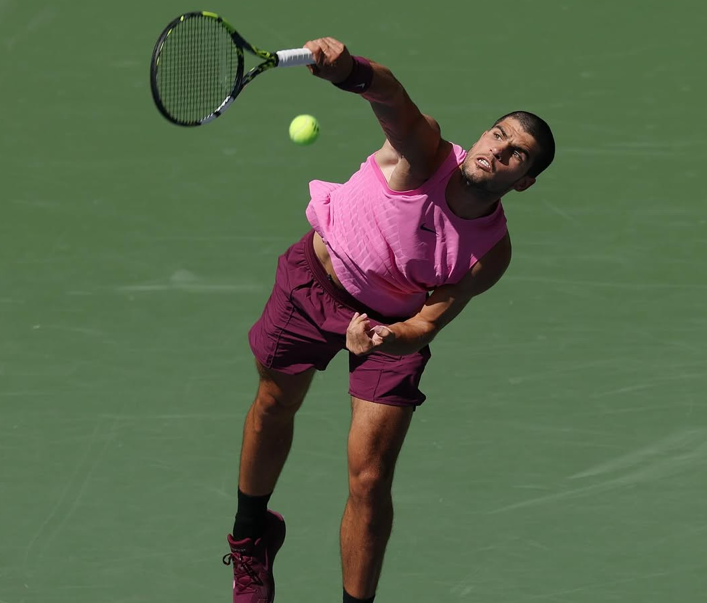
For fans watching from the stands or on TV, tennis might seem like a game of elegance and precision—players sprinting across the court, executing perfect serves, and engaging in thrilling rallies. But behind the glamor lies a more technical reality: tennis professionals are constantly battling the surface beneath their feet, and it’s no secret that many of them frequently voice frustration about court conditions. It’s a scene that has become almost routine on the ATP and WTA tours: after a grueling match, the cameras pan to a top player wiping sweat from their brow and shaking their head, muttering about the court or the surface. We often see stars like Carlos Alcaraz, Novak Djokovic, and several others expressing their concerns ranging from inconsistent ball bounce to slippery or overly sticky surfaces, and here are some examples.
Not all courts are created equal. Tennis is played on hard, clay, and grass surfaces, each with its own characteristics. Even within a single category, slight differences in materials, maintenance, and age can change how the ball behaves. For example, a hard court in Miami might feel faster than one in Tokyo, or a clay court in Madrid may retain moisture differently than one in Rome. These small variations can affect timing, footwork, and strategy, turning a seemingly minor issue into a major competitive advantage. For someone like Djokovic, whose game relies on precision and balance, even minor inconsistencies can turn a clean strike into an error.
During the 2021 AO, Novak Djokovic didn’t look too pleased with the faster courts. He raised some serious concerns after his second-round match against Frances Tiafoe. The Serb said it felt like he was playing on “ice.” He further went on to add, “I don’t know what the reason for that but it keeps getting faster and faster. You need to serve well, if you don’t, if you’re playing against someone that is solid, it’s tough to win matches on this court.” However, the Greek star, Stefanos Tsitsipas, had a slightly different opinion on this.
He said, “I find Rod Laver may be one of the slowest courts out there, I think, yeah. Other courts feel quicker to me.” But Pablo Carreno Busta gave a nod to Djokovic’s statement by saying that the tournament organizers had “gone too far” in making the courts so fast. Do faster courts do some real damage to the players?
According to Rafael Nadal’s statement from 2024, “If you want to talk about why people get injured, I'll tell you very clearly: when you push your body to the limit, you eventually get injured. When the game gets faster and faster, you get injured. When you play most of the year on hard courts and the surfaces are harder on the body, you get injured. That's the simple answer.”
His compatriot, Carlos Alcaraz, has time and again raised his voice on inappropriate tennis surfaces. Last year, after securing a victory against Nicolas Jarry in the second round of the Paris Masters, Carlitos made his feelings clear on the court speed at the tournament and the inconsistency of conditions on the Tour. He stated that the courts in this tournament should be a little bit slower, as he feels this would make tennis more “exciting” for the fans.
This year, the Indian Wells organizers announced that the event had a new partner, and hence they would be switching from a court surface by Plexiclave to Laykold.
On one side, players like Aryna Sabalenka claimed she absolutely loved these faster courts, while others like Elena Rybakina said it’s not much faster. Carlos Alcaraz highlighted how the court played differently between night and day. He felt that during the morning, it was “super slow.” Even the Russian star, Daniil Medvedev, added that it seemed much slower than before.
Faster or Slower? Well, different players had different opinions on that. Even during the 2025 US Open, the court speed became the talk of the town in the tennis world. Although US Open organizers claimed that the courts are the same, medium-fast speed, Alexander Bublik called them “pretty fast,” and Alex de Minaur labeled them as “quick and skiddy.” However, another Aussie star, Jordan Thompson, claimed that these courts weren’t that fast this year. Why do different players have different opinions after playing on a similar surface?
Well, according to Craig O’Shannessy, a respected data analyst and coach, players are often the worst judges. In an interview with ESPN, he said, “It's because it's all about their personal preference. When they say it's fast, that needs to be prefaced with 'it's fast for them,' or 'it's slow for them.' Certain game styles, players from Spain, Argentina, South America, they're going to enjoy a slower surface, with the ball that bounces up more, and if the court is not behaving that way, if it's maybe even coming through lower at the same speed, it's going to feel different for them, and they could quite easily say it's fast when maybe it's just lower.”
According to O’Shannessy, court speeds will vary according to how much tennis has been played on them. So, there is always going to be debate on this topic. But recently, the Swiss Maestro, Roger Federer, made a very interesting statement.
Roger Federer’s bold claim about Carlos Alcaraz and Jannik Sinner’s recent dominance
If we take a look at the ‘Sincaraz’ rivalry, these two have faced each other 15 times since 2021, with Alcaraz leading the H2H record by 10-5, including 4-2 at majors and 5-2 in the finals. They have already played three Grand Slam finals against each other. Carlos Alcaraz won the French Open against Jannik Sinner in a five-set thriller. But the Italian managed to take his revenge on Alcaraz in the Wimbledon final. However, the Spaniard had the last laugh at the US Open!
Commenting on their dominance in the men’s Tour over the past two years, Roger Federer stated that the tournaments are slowing the surfaces down to increase the chances of having more finals between Sinner and Alcaraz.
In the ‘Served with Andy Roddick’ podcast, the Swiss maestro said, “I understand the safety net that the tournament directors see in making the surface slower. It’s for the weaker player – he has to hit extra amazing shots to beat Sinner, whereas if it’s quick, he can only maybe blast a few and, at the right time… and he gets past. So that’s what the tournament directors are [thinking], like: ‘I kind of like Sinner-Alcaraz in the finals, you know? It kind of works for the game’.”
However, as per Carlos Alcaraz’s fierce rival, Jannik Sinner, “The hard courts, they are at times very similar. At times there are some small changes, couple of changes. One tournament that comes up a bit is Indian Wells because the ball bounces very high. It’s a bit different how the ball reacts with the court. But yeah, if not, we have more or less similar game situations on the court, yes. This is how it is already since a long time, like this. I don’t know if there is going to be a change or not.”
In that pre-tournament press conference at the China Open, Sinner claimed he’s just a player who tries to adapt himself in the best way possible. But do you think that these “slower” courts are favoring Sinner and Alcaraz a bit in recent times?
Written by

Sayantan Roy is a seasoned tennis journalist at EssentiallySports. He brings a deep tactical understanding to his coverage, breaking down head-to-head records, match dynamics, and on-court strategies with precision. For more than two years, Sayantan has been a key member of the Live Events desk, delivering real-time insights and data-backed predictions for the platform’s Matchday Preview section. His analytical approach has sparked editorial debates and drawn recognition from respected tennis voices, including commentator and analyst Olly_Tennis. Combining his experience in writing with a passion for insightful sports journalism, Sayantan’s work serves as a trusted reference point for tennis fans around the world.
Know more